



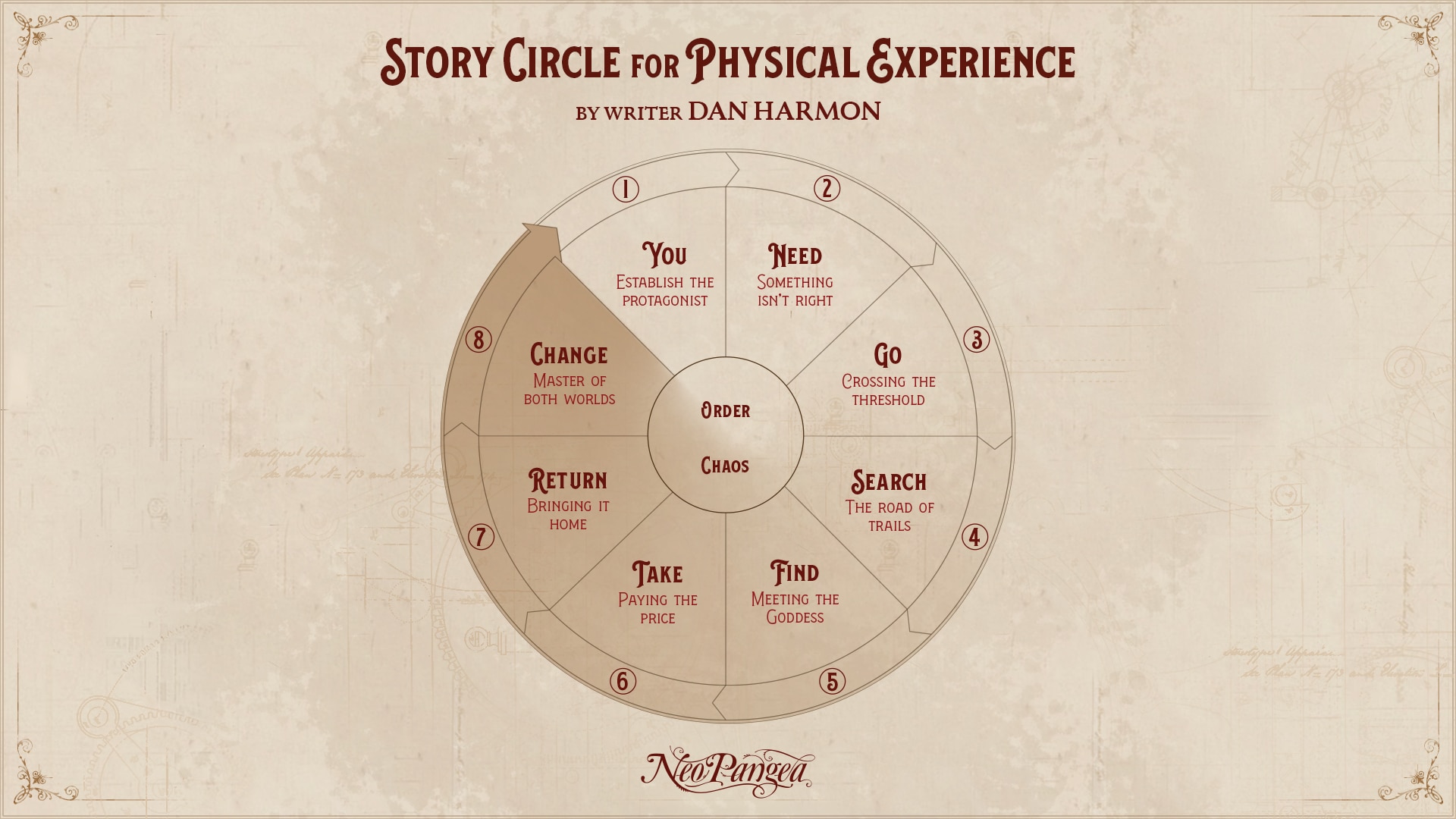
How the “Story Circle” Narrative Fits Physical Space
While outlining narrative structures for an immersive Museum in China about Longevity, I found myself going down a familiar creative rabbit hole.
Not the easy “what is the plot” rabbit hole.
The more dangerous one.
“How does this feel to a visitor in a physical space?”
Because when you are designing an experience people physically move through, you are not just building moments. You are building a journey. And if that journey does not have a clear arc, people feel it. Even if they cannot articulate why.
So, I went back to something simple and incredibly effective: the Story Circle, developed by television writer Dan Harmon.
If you are not familiar, it is essentially a distilled, practical version of Joseph Campbell’s Hero’s Journey. Eight beats. Clean. Functional. The kind of structure you can actually use without needing a whiteboard and a minor existential crisis.
Harmon used it to write for television. Most notably, stories that balance absurdity with surprisingly sharp emotional arcs. Which, honestly, is not that different from designing immersive environments.
What clicked for me is this: the Story Circle does not care what medium you use. It only cares that something changes.
I started asking a different question.
- What if this was not a script?
- What if this was in a building?
- What if real people were the characters, not actors.
When the Visitor Becomes the Protagonist
In traditional storytelling, you are guiding a character. In physical storytelling, you are guiding a person. A real one. With opinions. And distractions. And a phone that keeps lighting up. So instead of writing scenes, you are designing conditions. Instead of dialogue, you are using space, light, sound, and interaction. Instead of cutting between moments, you are controlling movement. Which means the structure has to hold up without words. That is where the Story Circle starts to shine. It becomes less of a writing tool and more of a spatial and narrative framework.
Here is how I have been thinking about it:
The Story Circle, Rebuilt for Physical Experience
- You
You are the protagonist. “You” creates an active tense immediately. This is not about a character somewhere else. This is about you, here, now. Who are you in this space? What is your role? What assumptions are you walking in with?
This is your baseline reality. And if you do not define it clearly, nothing that follows will land as hard as it should. In physical space, this is the threshold moment. The entry. The first room, the first sightline, the first sound. The space quietly tells you who you are before you even realize it.
- Need
Two forces begin to pull. The external need is the obvious one. The thing pushing you forward. The question being asked. The promise being made. The internal need is quieter. It is what the visitor brings with them. Curiosity. Fear. Ambition. Doubt.
Good experiences engage both. Great ones make them collide. In space, this is where intention becomes directional. What draws you deeper? A chaotic visual pull, immersive sound cues, a piece of physical information that feels just incomplete enough to make you move.
- Go
This is the step into chaos. Something happens that feels like progress. Like you are moving toward solving the need. But in doing so, you open up a much bigger set of complications. This is the moment where the experience stops feeling safe and starts feeling alive.
Physically, this is a shift. A change in art direction, content, perspective, scale, light, density, or orientation. A doorway, a transition, a moment where the environment tells you that you are no longer in control in the same way and you need to make a choice to move forward into a new direction.
- Search
The road of trials. This is where the world expands. More information. More friction. More contradictions. Every interaction, every room, every reveal should do two things at once: Move the visitor forward and Make things more complicated.
In space, this is sequence. Layered rooms, branching paths, interactive moments, competing signals. The visitor is navigating, choosing, interpreting, and slowly realizing there is more going on than they first thought. If everything gets easier, the story dies.
- Find
The critical moment. You find what you thought would solve the need. ….and then it does not. It goes sideways. It is incomplete. It raises new problems. The plan breaks.
This is often a reveal. A centerpiece, a data point, a perspective shift. Something that looks like an answer but reframes everything instead.
This is one of the most important beats, and one of the easiest to skip. But without it, the story feels flat. Too clean. Too predictable.
- Take
You get what you want. But you have to pay for it. There are consequences. Trade-offs. Costs. Sometimes subtle, sometimes brutal. This is where the story stops being polite and starts being honest. It is also where the internal need starts to shift. What you thought you wanted may not be what you actually needed.
This can be revealed with compression, intensity, or confrontation. A narrowing path, an overwhelming moment, a forced pause. The environment makes you feel the weight of the decision.
- Return
You begin moving back toward where you started. But it is not a clean return. It never is. You are changed. The world might look familiar again, but the tension is different. The original need might still be pulling at you. Or fighting you.
Physically, this is an echo of earlier space. Similar materials, similar forms, but perceived differently. The visitor recognizes the world, but no longer reads it the same way. Everything is exposed now.
- Change
The final conflict. Internal, external, or both. Something has to resolve. This is where the transformation is earned. Not given. We are at the climax. A final interaction, a decision point, a visual synthesis moment where everything comes together and asks something of the visitor.
If nothing truly changes here, the entire journey feels like a loop instead of an evolution.
- Back to You
You return. Same world. Different perspective. You see it differently now. You understand it differently now. Ideally, you understand yourself differently now. You have reached the exit. The decompression. The moment you step back into the real world carrying something with you, whether you wanted to or not.
And if that lands, even subtly, the experience sticks.
Why This Structure Works So Well in Space
What I appreciate most about the Story Circle is that it is not precious. It does not try to impress you. It just works. It is a skeleton. And in immersive design, that is exactly what you need. Something strong enough to hold the experience together, but flexible enough to let creativity do its thing. Because the reality is, people do not remember every detail of an exhibition. They remember how it unfolded. They remember when things got interesting. When something surprised them. When something challenged them. When something shifted. That is story structure. Whether we call it that or not.
The Fun Part
Also, there is something deeply satisfying about realizing that a framework used to write episodes of television can just as easily guide thousands of people through a physical environment on the other side of the world.
Same structure. Different medium.
Same human brain trying to make sense of what is happening. We are all just walking story processors.
Open Question
Curious how others are approaching this. Have you adapted classic story structures into spatial storytelling, exhibitions, or immersive environments? Have you experimented with the Story Circle in physical space?
I would love to chat about how others are building narrative arcs you can actually walk through!